Identification help for "papmacska" caterpillars. Distinguishing between common, black and brown tiger moths and fox moth caterpillars
In late autumn and spring, when walking in forests and fields, we often see large, dark-colored, hairy caterpillars crossing the road or feeding on some herbaceous plant. People familiar with folk language easily call these "papmacska", but this name is only used for tiger moth caterpillars, primarily the garden tiger moth (Arctia caja) caterpillar, while the above description fits more species. With this article, I would like to help with their identification and distinction.
The izeltlabuak.hu website primarily focuses on arthropods found in Hungary. This entry also deals with Hungarian fauna.
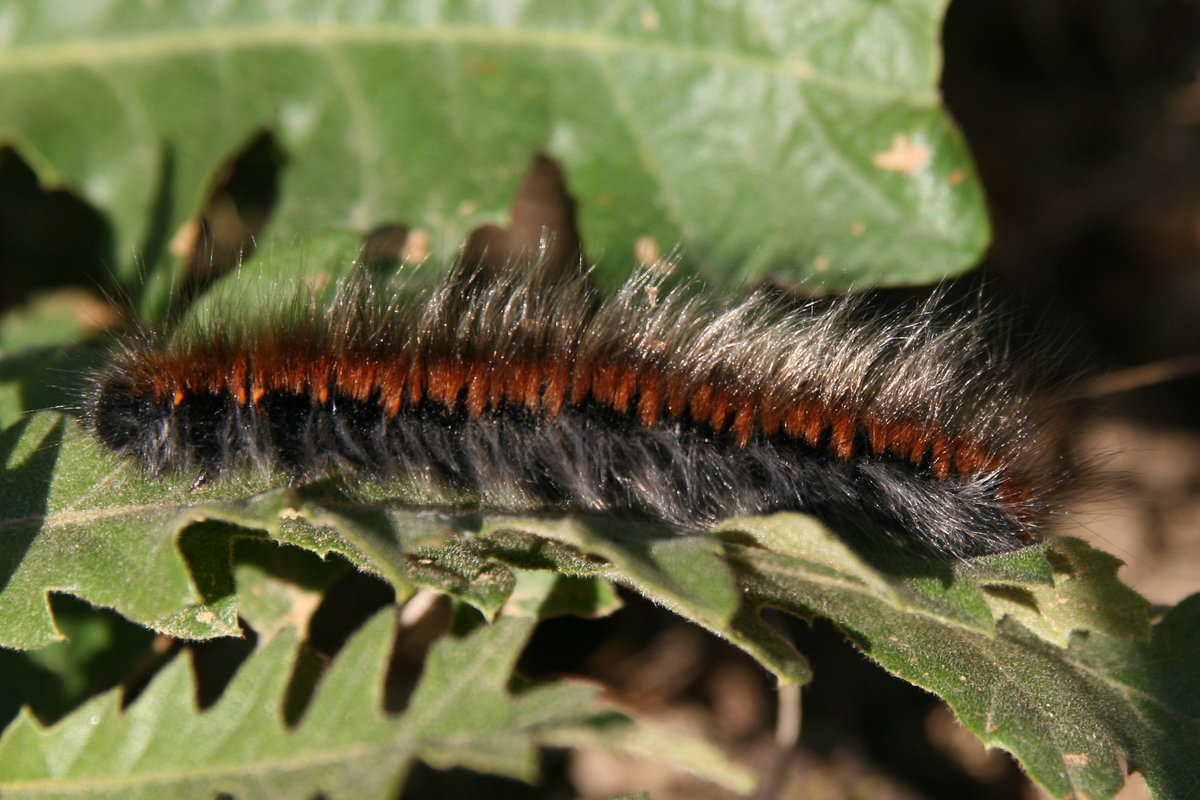
Macrothylacia rubi - fox moth
The caterpillar of the fox moth (Macrothylacia rubi) is the subject of misconceptions. It is a common species that occurs throughout the country, so we can easily encounter it. It develops on various herbaceous plants during the summer, then in autumn, sometimes already at the end of August, beginning of September, the caterpillars set out to find a suitable place for themselves to overwinter. After overwintering, they appear again at the end of March, beginning of April, to pupate after a few weeks of feeding. The moth flies from the end of April to June.
The caterpillar is large, can reach up to 8-10 centimeters. Its base color is black, its back is covered with dense, short, rusty brown hair. Its midline is black, from which long, brown hairs grow. The ventral side is black, along the lateral line long, gray or white hair stripes grow. Its head is covered with short hairs.
When defending, the caterpillar curls up, at which time the light yellow bands between the segments become visible. Its hair is dense, short, and may cause mild skin irritation in some cases. Freshly hatched caterpillars are black or dark gray, with long, light hairs and white or pale yellow rings between the segments.
After the second molt (L3 stage), the rings become bright yellow and wide, well visible, at this time - also due to the occurrence time - it can be confused with the cinnabar moth (Tyria jacobaeae) caterpillar, but while in the case of the fox moth the base color is dark and the rings between segments are yellow, in the cinnabar moth it is exactly the opposite.
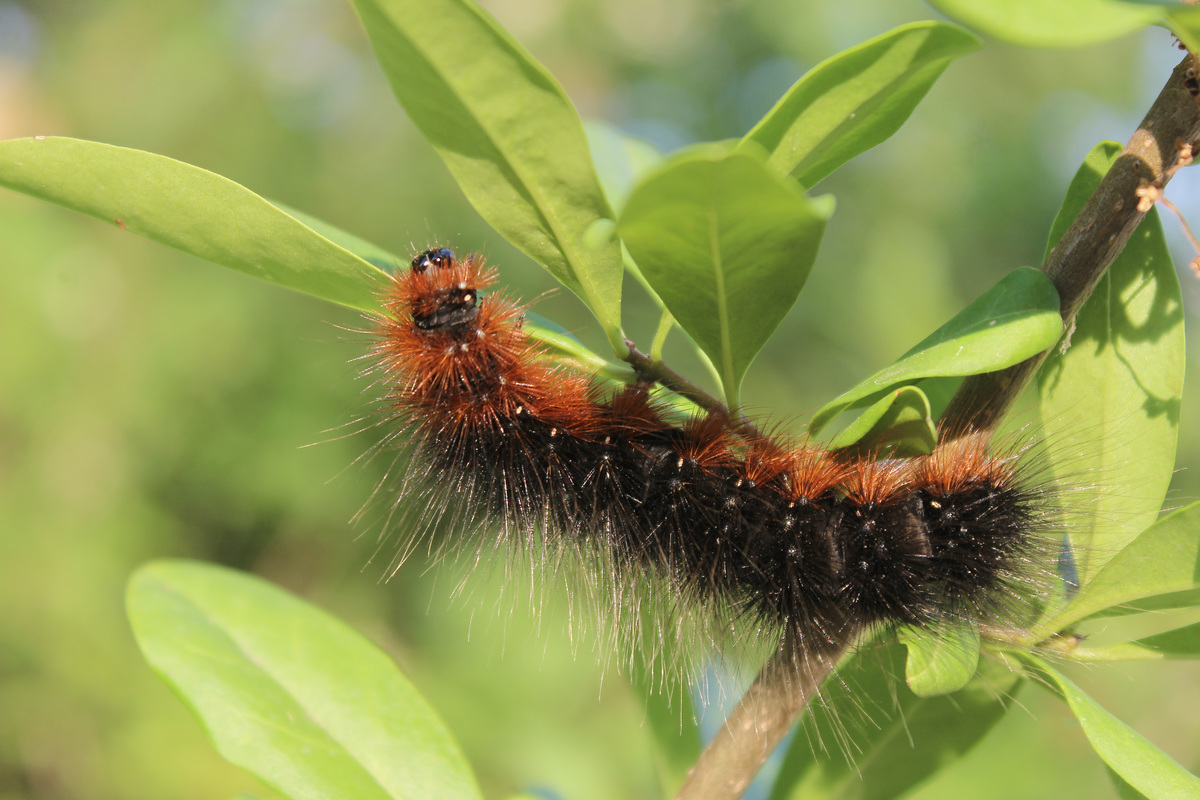
Arctia caja - garden tiger moth
The garden tiger moth (Arctia caja) was once a common species throughout the country, but has now significantly declined and become local. It develops mainly on herbaceous plants, its preferred host plants are plantain species (Plantago spp.), dandelion (Taraxacum), but it also consumes many other plants, such as Rubus-, Sonchus-, or Allium species, but it also eats the leaves of Russian olive (Elaeagnus angustifolia). Young caterpillars a few centimeters long overwinter, emerge in spring, reach their final size and the characteristic "papmacska" appearance by May-June. The moth flies from the end of July to the beginning of September.
The caterpillar is large, grows to 6-8 centimeters, appears somewhat stocky due to its long, dense hair. Its base color is black, its hair around the head and on the ventral side - extending to the conspicuously white spiracles - is orange or bright rusty red throughout. On its back, long hair strands often ending in silver or white grow. Its head is bare.
Other similar species
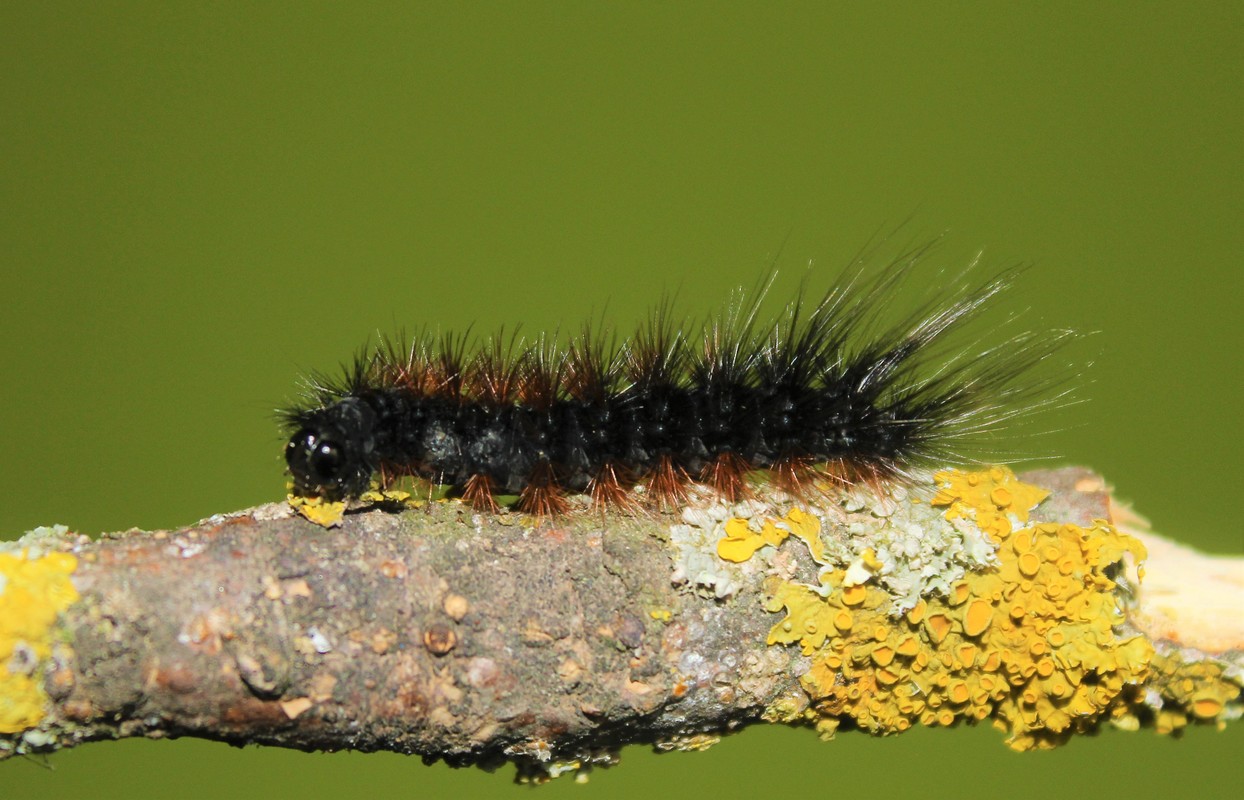
Hyphoraia aulica - brown tiger moth
The brown tiger moth (Hyphoraia aulica) is not very common, a local species, according to my experience it occurs mainly in wet habitats. Its host plants are mainly plantain (Plantago), spurge (Euphorbia) and yarrow species (Achillea), more rarely dock (Rumex) or blackberry (Rubus), dandelion (Taraxacum).
Young caterpillars overwinter, at which time their back is still completely black. The moth flies from early May to June.
The caterpillar is smaller than the above species, 4-5 cm, its base color is black. Its hair from the 3rd segment to approximately the middle of the back is rusty red, gradually darkening; on the ventral side the red stripe extends to the same point, but is more intense. Its side is black. On the back, longer hairs only grow from the last few dark segments. Its head is bare.

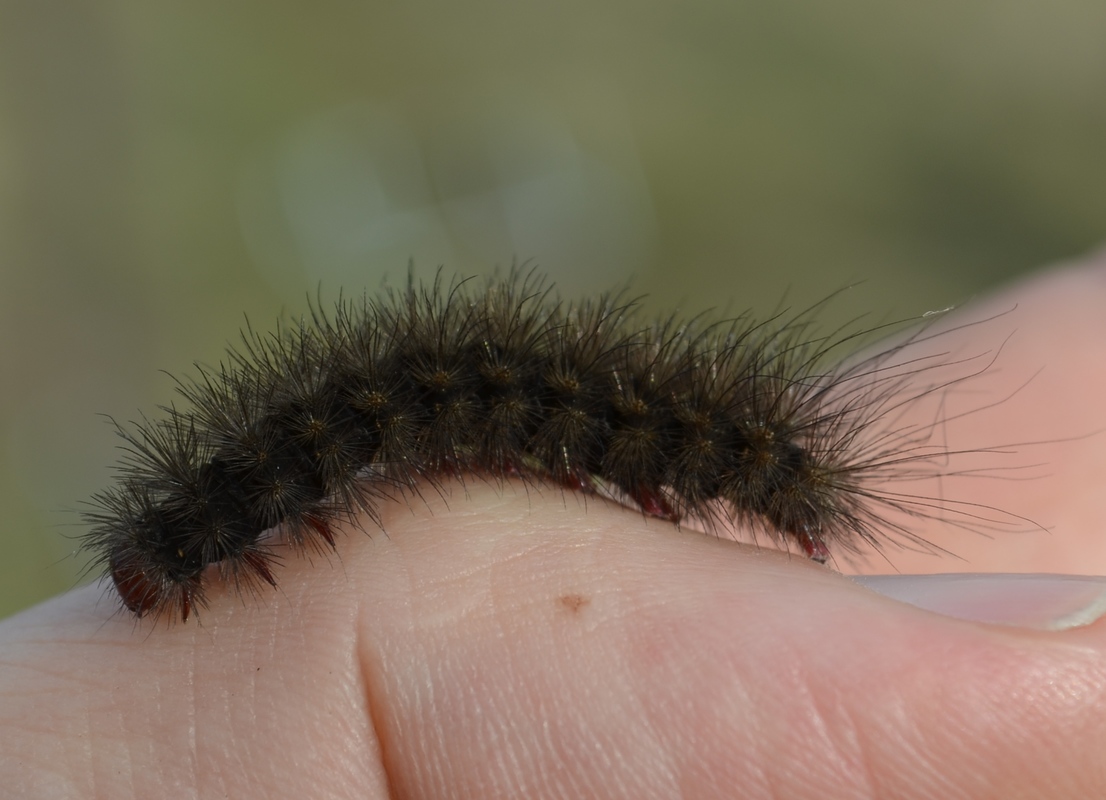
Arctia villica - cream-spot tiger
The cream-spot tiger (Arctia villica) is a widespread species, but occurs in larger numbers only in a few places, it prefers forested areas. Its main host plants are dandelion (Taraxacum), plantains (Plantago), yarrow (Achillea), strawberry (Fragaria), nettle (Urtica). The caterpillar overwinters, the moth flies from May to June.
The caterpillar is 5-6 cm, its base color is dark gray or grayish brown. Its hair is short, consists of brownish or grayish tufts growing from the tubercles, longer strands only grow from the last segments. Its head is bare, reddish in color like the legs and prolegs.
In early spring, the caterpillars of the nine-spotted moth (Amata phegea) that also emerge from overwintering are similar in color and their head and legs are also red, but their hair is much denser, arranged in rings, and they are significantly smaller in size.