Misinformation about kissing bugs
This year, a hoax about a so-called "kissing bug" that spreads disease is circulating among Hungarian websites. With this article, I would like to dispel the fears that arise from this. In short: we don't need to be afraid of it, such a dangerous animal does not live in Hungary, or even in Europe.
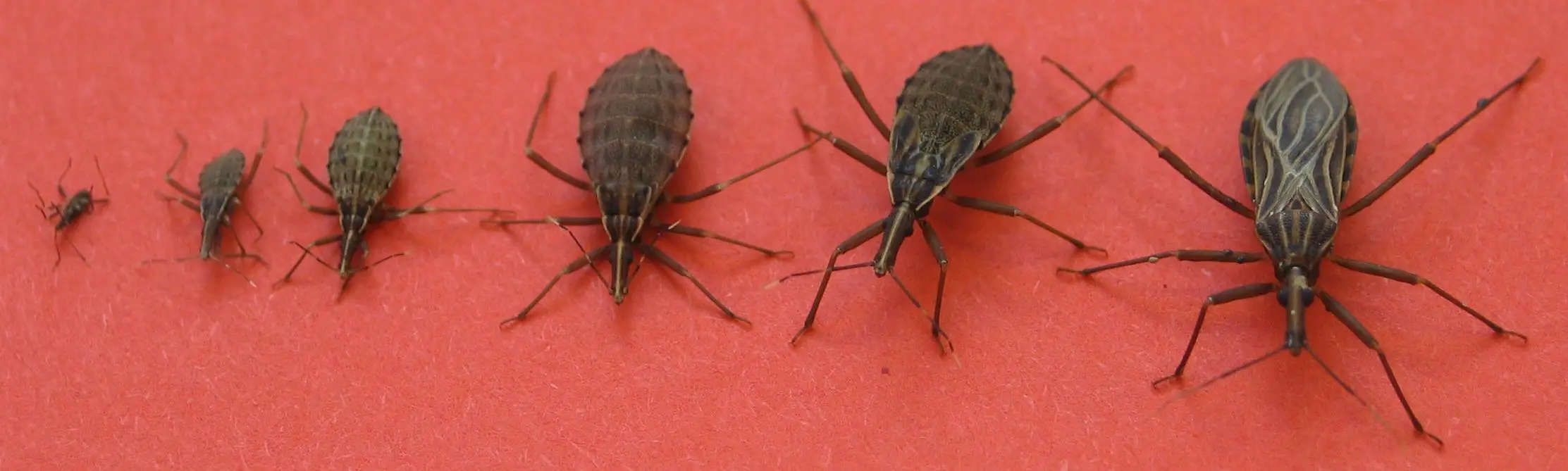
Rhodnius prolixus
Original title: Rhodnius prolixus (ninfas y adultos)
Author: Thierry Heger
Source: https://en.wikipedia.org/wiki/Triatominae
The izeltlabuak.hu website primarily focuses on arthropods found in Hungary. This entry also deals with Hungarian fauna.
Several websites have recently published articles claiming that we can encounter this animal in more and more places, that they attack areas around people's eyes and mouths, and that they spread deadly diseases. They describe the symptoms and how we can reduce the risk of encountering the animal.
These claims are undoubtedly frightening, but we have no reason to be afraid - they are not true. Regardless of their factual content, hoaxes and alarmist news generate many likes, shares, and visitors. These articles also fall into this category. The sense of credibility is further enhanced when we encounter the articles on seemingly reliable websites. These writings already existed in 2016. Their characteristic is that almost the same content was copied by all Hungarian sites where they appeared, with minor variations. They also contained source citations, but these links point to each other. They are unprofessional, for example, they use the word "beetle". True bugs are not beetles. Beetles are classified as an order (Coleoptera), while true bugs (Heteroptera) are a suborder under the order Hemiptera. Another example is the use of the word "breed" instead of "species". We don't usually breed insects for domestication purposes, so the word "breed" doesn't hold up in their case. However, these may not be known to those who don't deal with insects in depth. These articles are harmful because their factual content is difficult to verify and they further increase hatred towards insects.
Let's see what we can know about the "kissing bug":
The Reduviidae is a family under the Heteroptera suborder. Members of this family also live in Hungary and are dangerous predators for insects, attacking a wide variety of insects. Well-known species include Rhynocoris iracundus or Reduvius personatus. They do not attack humans, but it is not recommended to disturb them, as if forced to defend themselves, they can deliver a painful stab with their proboscis. However, this rarely occurs.
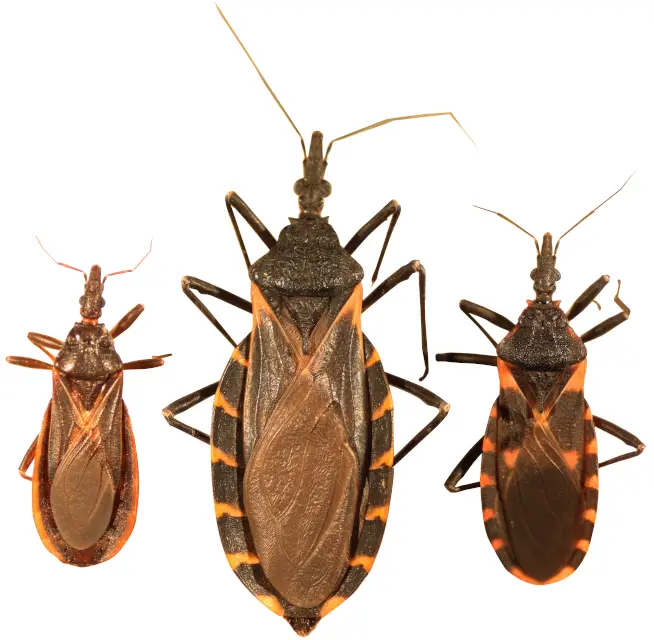
Triatoma species. (left to right) Triatoma protracta, the most common species in the western U.S.; Triatoma gerstaeckeri, the most common species in Texas; Triatoma sanguisuga, the most common species in the eastern U.S.
Original title: (Left to right) Triatoma protracta, the most common species in the western U.S.; Triatoma gerstaeckeri, the most common species in Texas; Triatoma sanguisuga, the most common species in the eastern U.S. Scale bar represents 25mm or approximately 1 inch.
Author: Curtis-Robles et al.
Source: https://commons.wikimedia.org/wiki/File:Three_species_of_kissing_bugs.PNG
This family has a subfamily called Triatominae. The species classified here are characterized by blood-sucking. The articles in question are about these. At least 130 species belong here, most of them live in the Americas, from the southern United States to northern Argentina. Some of their species also live in Asia, Africa, and Australia. I was not able to find a credible source about them spreading. It is more likely that they are increasingly coming into focus, so we learn about more occurrences than before. The species belonging to this subfamily are commonly called "kissing bugs", the name does not refer to a specific species.
They are active at night, when they hunt. On sleeping humans, the skin around the mouth and eyes is thinner, so they tend to pierce there to suck blood. After feeding, they defecate near the wound. The victim, upon waking up, may rub the wound and thus introduce the feces into the wound or into the eye. If the bug was infected, the pathogen can enter the body with this feces. The disease itself is called Chagas disease, caused by a parasite called Trypanosoma cruzi. Not all species in the subfamily are characterized by spreading the disease.
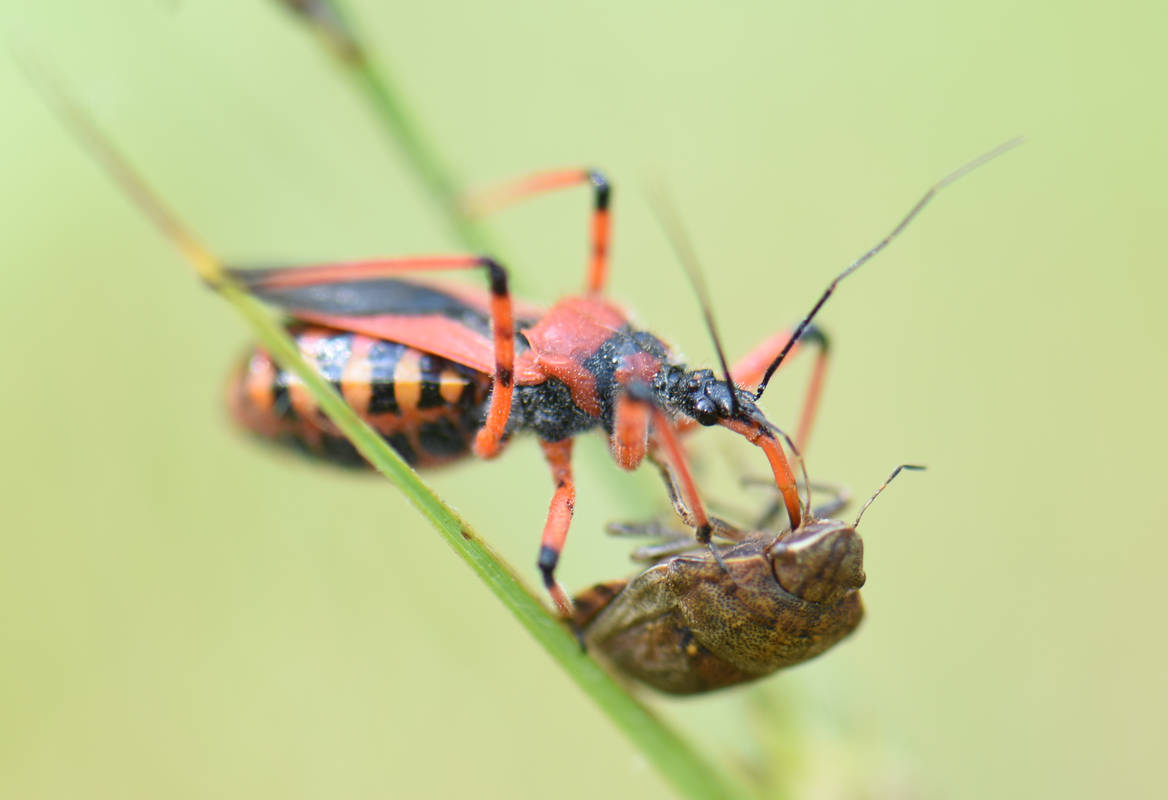
The local assassin bugs are therefore not dangerous, in fact, we can say they are useful, because among their victims there are many pests. They are extremely beautiful, if you walk in meadows in nature, you can encounter them as they hunt or consume their prey, just look:
Sources used
- http://kissingbug.tamu.edu/faq/
- https://www.cdc.gov/parasites/chagas/gen_info/vectors/
- https://en.m.wikipedia.org/wiki/Chagas_disease
- https://en.wikipedia.org/wiki/Triatominae
- Berend Aukema, Christian Rieger: Catalogue of the Heteroptera of the Palaearctic Region
- Pavel V. Putshkov & Pierre Moulet: Faune de France 92 - Hémiptères Reduviidae d'Europe occidentale
- Kondorosy, E. (1999): Checklist of the Hungarian bug fauna (Heteroptera) - Folia entomologica hungarica 60: 125-152.